下載app免費領取會員





設計單位? Sn?hetta+70°N architecture+Joar Nango
項目地點? 挪威
建成時間? 2024年
建筑面積? 7,200平方米
在2021年新薩米劇院及學校的建筑設計競賽中,Sn?hetta與70°N建筑事務所、藝術家Joar Nango合作設計的方案獲得優勝。現在,這座引人注目的建筑已經落成。
Sn?hetta, together with 70°N architecture and artist Joar Nango, delivered the winning proposal in the architectural competition for a new Sami theatre and school building in 2021. Now, the prominent building has been inaugurated.


?oarvemátta這個名字在薩米語中意為“角”和“根”,指馴鹿鹿角內側最堅固的部分。它象征著不同的品質和力量,也代表著團結,因為這座建筑將由不同機構共同使用:薩米國家劇院、薩米高中以及馴鹿放牧學校。
The name ?oarvemátta comes from the Sámi words for horn and root, after the innermost and strongest part of the reindeer antlers. This symbolizes different qualities and strengths and represents elements that unite, as ?oarvemátta will be a unifying force for the institutions that share the building: the Sami National Theatre Beaivvá? and the Sami High School and Reindeer Herding School.


設計和建筑 Design and Architecture
新建筑位于挪威Finnmarksvidda高原中部的Kautokeino市鎮上。大樓的四個外立面以不同的方式與周圍的多樣化景觀空間產生互動。
The new building is located in Kautokeino in the middle of Finnmarksvidda, Norway's largest and northernmost plateau. All four of the building's facades relate to the various landscape spaces that surround it in different ways.
建筑坐落在地勢較低的地方,其比例與周圍的山丘高地相協調,建筑呈現順滑的有機形態,沒有尖角。南、北兩側傾斜的屋頂使得建筑從遠處看去時的高度被最大限度地降低,同時還在西南側創造出一個入口。
The building sits low in the landscape and has proportions that harmonize with the surrounding hills and heights with no sharp angles breaking with the organic forms. The sloping roof on two sides (north, south) minimizes the project's height effect seen from a distance, and at the same time creates an entrance situation towards the access from the southwest.


新的公共空間呈“Y”形,主入口和前廳位于中央,為學校和劇院的使用者創造了一個碰面地點。建筑主體從這一中心向三個方向延伸——劇院,工作室及教室,學校行政部門各占一翼。
The new shared space has a branching shape, with a main entrance and vestibule located at its center, creating a gathering place for both the school's and the theater's users. From here, the building body stretches in three directions – with one wing each for the theatre, workshops and teaching rooms, and the school's administration.
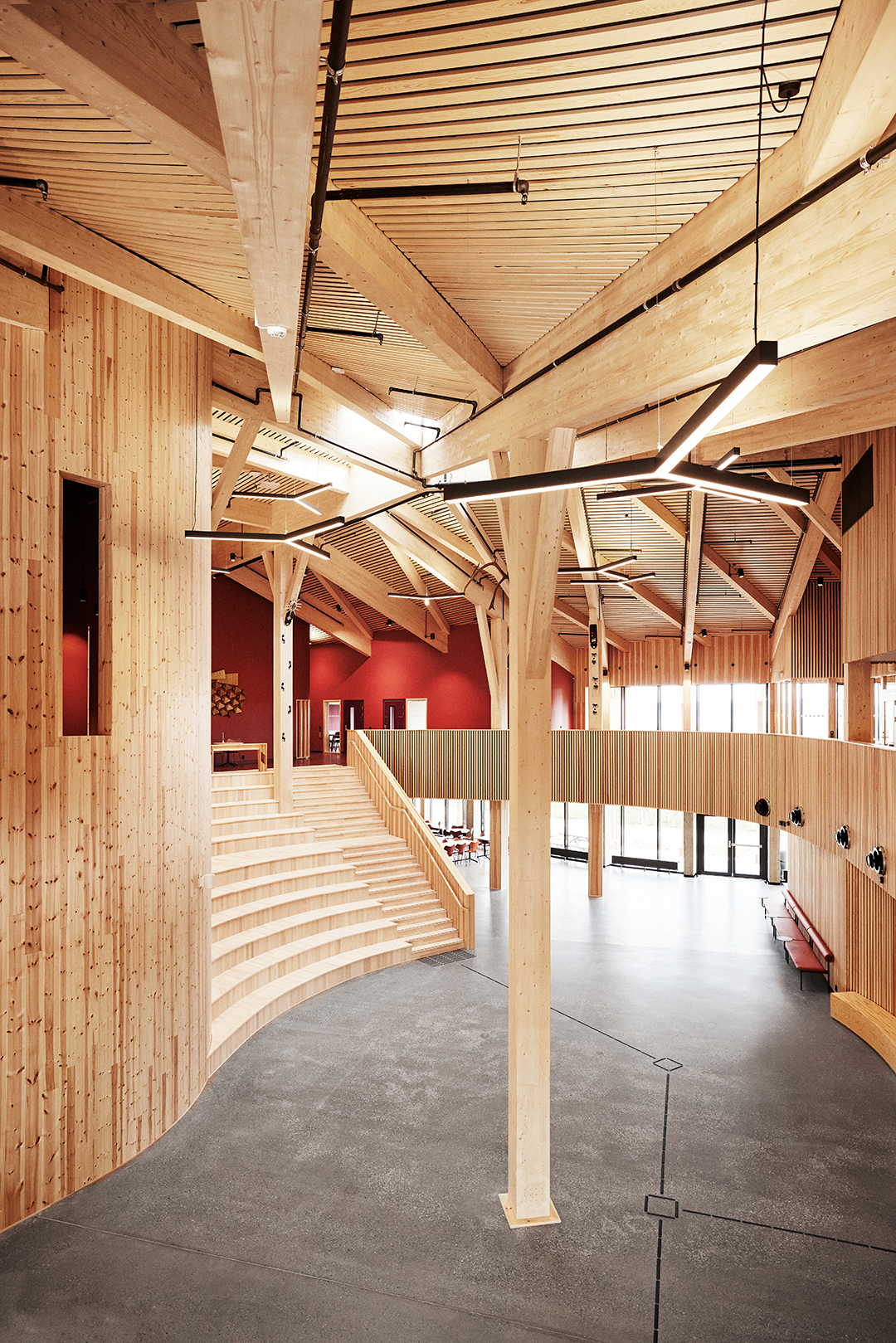
弧形線條、帶有天窗的前廳以及可見的木質承重結構,其靈感均來自薩米地區的典型木構,如“lávvu”帳篷。
The curved lines, the vestibule with skylights as from a reahpen, smoke hole, and the visible load-bearing timber structure in wood, are inspired by wooden structures typical of reindeer herding Sámi areas, such as the lávvu.


材料和色彩 Materials and color
建筑的立面以經過處理的松木板覆蓋。巨大的屋頂面積達4,930平方米,鋪設了34,000米長的kebony木制品。劇院山墻上重新利用了從村里已拆除的小學回收的Alta石板。
The fa?ade of the building is made of standing wood clad in ore pine. The massive roof measures 4930 m2 and is clad with 34,000 meters of kebony. The Alta slate stone on the theatre's gable wall has been reused from the village's old primary school, which has been demolished.


在前廳和走廊內,拋光的混凝土地板模仿了建筑外的地面,并采用了當地開采的板巖、馬西石英巖等,石材呈現出不同層次的灰色和綠色。
Inside the vestibule and corridors, the polished concrete floors mimic the ground outside the building, with elements of locally mined stone, including slate and masi quartzite, in various shades of grey and green.

建筑的中心,即門廳、前廳和劇院大廳周圍,采用了溫暖的紅色調。然后,離中心的距離越遠,色調就越冷,建筑三個翼的末端都是偏藍的色調。門、墻和地板之間的顏色差異,明顯參考了薩米人對色彩的使用。室內配色與一年中大部分時間都被白色覆蓋的建筑外觀,形成了強烈的對比。
The center of the building, around the foyer, vestibule and theater halls, is painted in warm, red shades. Then the color scheme becomes cooler the further away from the source you get, with bluish tones at each end of the building's wings. Contrasts between door, wall and floor within the different color schemes have clear references to Sami use of color. This makes a strong contrast to the building's exterior, which is clad in white for the most part of the year.


景觀 Landscape
建筑的“Y”形形狀自然劃分出三個戶外空間。朝南的是主入口前的空間,被學校和劇院共享。這個具有親密感的圓形空間設有烤火坑、能坐人的石頭和露天劇場。這些石頭就是從不遠處的高原開采的。此處使用的Alta板巖來自場地附近的采石場。
The branching shape of the building naturally forms three outdoor spaces. The one facing south constitutes the main entrance and a space in front of it. The forecourt is an intimate and circular space with arrán, a fire pit, sitting stones and an amphitheater. The sitting stones are taken from the plateau just outside, and this flexible room can be used by both school and theatre. The Alta slate used here comes from a quarry near the construction site.


劇院翼樓另一側的戶外區域,被學校用來開展教學活動。設計使得這個區域既在視覺上受到一定的遮擋,又能避開當地的盛行風向和惡劣天氣。
The outdoor area on the other side of the theatre wing is intended for the school's building trade workshops and is shielded both visually and from the prevailing wind direction and harsh weather at Finnmarksvidda.
建筑北側則有大片由當地專家指導建造的馴鹿圍欄,并與建筑內的馴鹿放牧翼樓直接連通。在建筑的東側,高原與建筑自然地相接,設計盡可能地將對于周邊地形、植被的影響降至最低。
North of the building, large areas have been set aside for reindeer fences, which are directly linked to the reindeer herding department inside the building and have been built by local experts. On the east side, the plateau meets the building in a natural way, and the terrain and vegetation have been preserved as close as possible to the building.

自然地熱供暖 Natural ground heating
該項目憑借其高建筑質量,良好的室內氣候和低能源需求,符合了被動建筑標準。
?oarvemátta meets the requirements of the Passive house standard, which means that the building is of very high quality, with a good indoor climate and extremely low energy requirements.
由于項目設置了40個深達地下250米的地井,該建筑90%的供暖和制冷能源都能自給自足。地井為兩臺既能制熱又能制冷的熱泵提供能量,而交換器則將多余的熱量回收。在冬季最寒冷的時候,該系統還能用電鍋爐補充供給。
The building is 90% self-sufficient in energy to heating and cooling thanks to 40 geowells drilled about 250 meters into the ground. The wells supply two heat pumps that both heat and cool the building, while exchangers for the energy wells dump surplus heat back again. On the coldest winter days, the system is supplemented with an electric boiler.


建設過程的填挖方在場地內達到平衡,被剝離的表層土壤被暫時儲存起來,隨后又被送回建筑周邊地表,以保證表土種子群的完好無損。
Over the entire construction site, soil that has had to be removed has been preserved, the top layer has been temporarily stored, and subsequently returned to all surfaces around the building, so that the seed stocks are intact.

標識和導覽 Signage and wayfinding
Sn?hetta還根據項目的整體視覺效果,制定了與建筑、室內和景觀設計相配的標識導覽方案。標識導覽主要是功能性的,但與建筑一樣,也微妙地借鑒了傳統工藝和材料使用。
Sn?hetta has also also made the signage and wayfinding program that follows the project's visuality and works complementary to architecture, interior, and landscape design. It is primarily functional, but like the building, it also has subtle references to traditional craftsmanship and use of materials.


標識由粉末噴涂鋼和松木制成,而排版和圖形都與建筑的排列相呼應。為了兼顧不同語種使用者的要求,能從遠距離辨認的圖標被廣泛運用。
The signs are made of powder-coated steel and pine, and the graphic elements, including typography and pictograms, mirror the building's alignment. Iconography is used extensively for readability at a distance to meet the requirements for multilingualism (Northern, Southern, Lule Sámi, and Bokm?l).




設計圖紙 ▽


完整項目信息
Shared building for the Sami National Theatre Beaivvá?, and the Sami Upper Secondary School and Reindeer Herding School
Location: Kautokeino/Guovdageaidnu, Norway
Size: 7200 m2
Typology: Cultural and educational building
Status: Completed
Timeline: 2020-2024
?oarvemátta meets the requirements for the designation Passive house according to the standard NS3701
Client: Statsbygg
Architecture, Interior Architecture, Landscape Architecture and Graphic design: Sn?hetta
Entrepreneur: Econor
Collaborating partner, architect: 70°N arkitektur
Collaborating partner, architect/artist: Joar Nango
Art acquisition: KORO, curator: Monica Milch Gebhardt
Artists: Máret ánne Sara, Laila Mari Brandsfjell, Fredrik Prost
Ellen Berit Dalbakk/Rámavuol Elle Bigge, Merethe Ella Márjá Kuhmunen, Elle Valkeap??, Britta Marakatt-Labba, Iver J?ks, Aage Gaup
Consulting Engineer, Building and Fire: Norconsult
Consulting Engineer, Building (Prefab): AB consult
Consulting Engineer, Acoustics: Brekke & Strand
Consulting Engineer, HVAC: Afry
Consulting Engineer, Pipes: SWECO
Consulting Engineer, Electrical: Ramb?ll ? ? ? ? ? ? ? ?
Consulting Engineer, Road: Asplan Viak
本項目由Sn?hetta授權有方發布,文字由有方編譯。歡迎轉發,禁止以有方編輯版本轉載。
本文版權歸腿腿教學網及原創作者所有,未經授權,謝絕轉載。

上一篇:政策新聞 | 關于進一步加強遼寧省建筑市場監管公共服務平臺項目信息管理的通知
下一篇:政策新聞 | 2024年山東省住房城鄉建設系統重點工程“聚焦新質生產力,服務高質量發展”創新創優勞動競賽調研觀摩會在山亭區舉行


推薦專題